


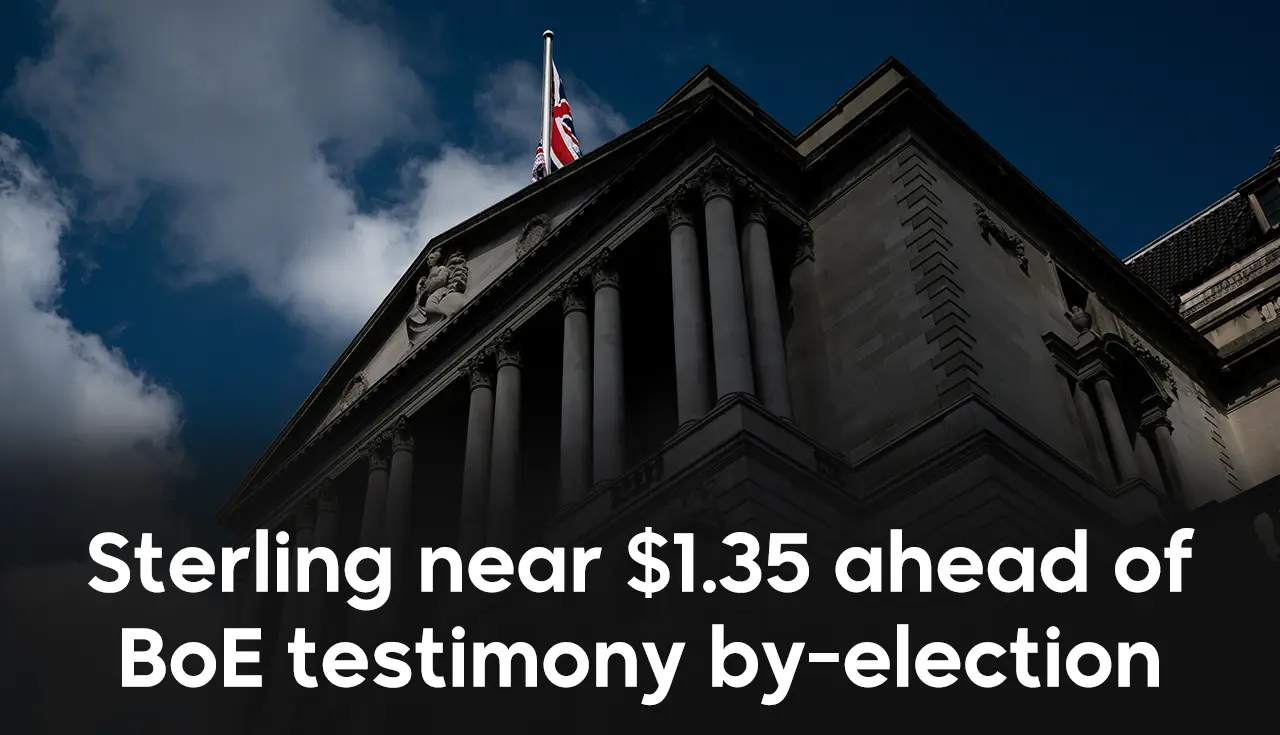
This week, currency markets are focusing on the British pound amid two key events that could reshape its short term trajectory. Foremost among these developments is the appearance of Bank of England Governor Andrew Bailey and Monetary Policy Committee member Megan Greene before the Treasury Committee. Market participants will scrutinize the tone of their statements closely.
Any clear inclination toward supporting a rate cut in the March 19 meeting could prompt markets to fully price in a 25 basis point cut, instead of the current partial pricing, which may translate into additional pressure on the British currency.
On the political front, the by elections in the Gorton and Denton constituencies represent a risk of comparable significance. A heavy defeat for the ruling Labour Party could raise questions about leadership stability within the party, heightening the pound’s sensitivity to domestic developments.
In actual trading, the EUR/GBP pair is hovering around 0.8734 with a slight upward bias, while GBP/USD remains near 1.3495. ING forecasts suggest that EUR/GBP could rise toward 0.88 by the end of the week if pressure on the pound increases, whether due to monetary policy concerns or domestic political developments.
Meanwhile, the U.S. dollar weakened at the start of the week following a Supreme Court ruling that struck down tariffs imposed by former President Donald Trump, a move that has brought U.S. trade policy back into the spotlight. The White House responded swiftly by announcing an alternative 15% tariff for 150 days, reintroducing market uncertainty and opening the door to prolonged legal disputes, particularly given the lack of clarity regarding previously collected duties.
As a result, the dollar index fell to 97.65, down roughly 0.2%, after posting strong weekly gains of nearly 1% its best performance in over four months. The movement reflects a rapid reassessment of risks tied to U.S. trade policy, at a time when investors are also monitoring developments in nuclear talks between Washington and Tehran, amid signs of an expanded U.S. military presence in the Middle East.
From a strategic perspective, some analysts believe the renewed trade dispute deepens the uncertainty surrounding U.S. policies, which could keep pressure on the dollar throughout 2026. Even if the court ruling strengthens the perception of institutional integrity, the likelihood of tariffs returning under different legal frameworks means ambiguity about the trade and financial path persists.
Conversely, the euro benefited from the dollar’s decline, pushing EUR/USD up to around 1.1799, supported by improved economic activity data in the Eurozone and a rebound in the manufacturing sector, alongside an increase in the German business climate index. Meanwhile, the pound held near 1.3497, supported by anticipation of the Bank of England governor’s testimony and the U.K. by elections both factors that could determine the currency’s direction in the coming days.
Broadly, ongoing uncertainty related to tariffs and geopolitical tensions may lead some currencies, such as the euro and yuan, to gain relatively, while others more tied to global trade could face additional pressures. Moreover, a rise in U.S. bond yields, should revenue gaps widen, could negatively impact equity markets if it leads to a decline in valuation multiples.
Stay informed about global markets through our previous analyses. and Now, you can also benefit from LDN company services via the LDN Global Markets trading platform.


