


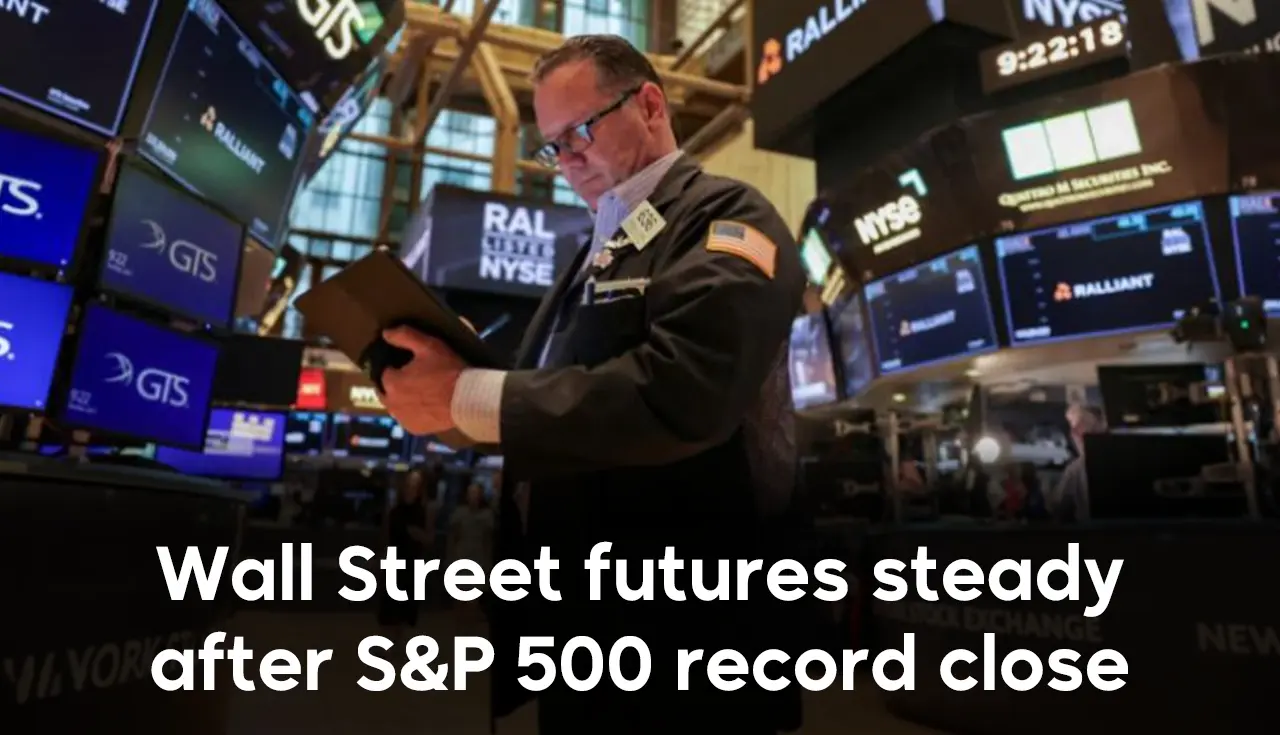
U.S. stock index futures held steady in Wednesday’s pre-opening trade, after the S&P 500 closed Tuesday at a fresh all time high. The stronger than expected Q3 GDP reading gave the market an added boost, showing that the U.S. economy continues to run at a solid pace supporting investor confidence that equities can maintain an upward bias.
Current trading conditions are marked by thinner liquidity as the Christmas holiday approaches, keeping price movement relatively contained. S&P 500 futures remain unchanged at 6,957 points, Nasdaq 100 futures dipped slightly by 0.1% to 25,796.5 points, and Dow Jones futures are flat at 48,735 points. These marginal shifts reflect a lack of fresh catalysts rather than any structural change in market direction.
U.S. stock exchanges are set to close early today at 1 p.m. ET for Christmas Eve, and will remain fully closed on Thursday for Christmas Day, likely keeping overall liquidity at a minimum through the end of the week. This seasonal slowdown may reshape short term trading behavior, but does not alter the broader technical landscape unless key support levels come under clear breakdown pressure.
Technically, U.S. indices continue to trade above core reference zones, preserving the broader bullish structure. Although the recent growth data briefly lifted Treasury yields, markets treated the reading as a backward looking print, unlikely to materially shift rate expectations or risk appetite at this stage.
Meanwhile, the U.S. dollar is heading for its largest yearly decline since 2017, pressured by thinner year end flows. Despite the robust Q3 GDP reading, rate expectations remain intact, with markets continuing to price in two additional 2026 Federal Reserve rate cuts, viewing the GDP reading as reflective of a past period rather than a driver for the next phase.
The euro and the British pound benefited from the softer dollar in recent weeks, climbing to fresh three month highs, before settling broadly flat at $1.180 for the euro and $1.3522 for sterling. The dollar index against a currency basket slipped to 97.767 points, its lowest in 2.5 months, and is on course to lose 9.8% this year, a drop that may widen if pressure extends into the final December sessions.
U.S. tariff policy was a major source of market turbulence this year, prompting investors to reassess exposure to dollar denominated assets. Increased White House influence over Fed policy fueled further caution around central bank independence, even as cooling inflation kept rate cut expectations delayed but not dismissed.
In the rates space, 2026 cut expectations remain present, as the market sees the U.S. economy resilient enough to absorb two potential reductions, even as inflation stays sticky and moderates the pace of easing decisions. The base case is not a cancellation of cuts, but a postponement of their impact, keeping risk appetite at reasonable levels without excessive rush.
Stay informed about global markets through our previous analyses. and Now, you can also benefit from LDN company services via the LDN Global Markets trading platform.


